Return to the Origin, Back to the Source
Tuere Sala | OCT 4, 2022
Return to the Origin, Back to the Source
Tuere Sala | OCT 4, 2022
Note: These last few pictures will be long posts. I try to make them shorter but they require more explanation. Take your time reading it, no need to rush. You have a whole month.
This month's picture is interwoven with last month's picture (It might be a good idea to go back and read the 2 months together). Picture 8 represents the opening of one's Dhamma eye (learning to see the emptiness in conditioned reality). In other words, picture 8 represents right view. Picture 9 represents what it's like to live with a picture 8 view. I think picture 9 is the sustaining of right view. Both pictures 8 and 9 seem to be pointed at how one perceives the world at this stage of practice. It's only in the last picture next month that we will talk about how one acts in the world at this stage of practice.
I think it is an important distinction, perception/view and action. Often I notice practitioners concern themselves more with action than they do their perception/view. Buddha's instructions, however, point mostly to perception or view. Action follows view so we would do well to pay attention to the view we are perceiving the world through. This is the significance of pictures 8 and 9. We have spent this last year cultivating right view and, at last, we are at a stage in practice where we can sustain it.
Let's look at the picture for a moment. To me, this picture represents life as nature. You will note that the foliage is more spacious than in previous pictures. It's lighter and brighter. There's no yogi, no ox and no path. I think this picture represents the truth that the human condition is as much a part of nature as trees, leaves, animals, and everything else. Here we come to understand that we do not go out into nature; we are part of nature (again I don't know what the writing says). It's good to take a moment and stare at this picture until you really get a sense that you are nature. You are not separate from nature.
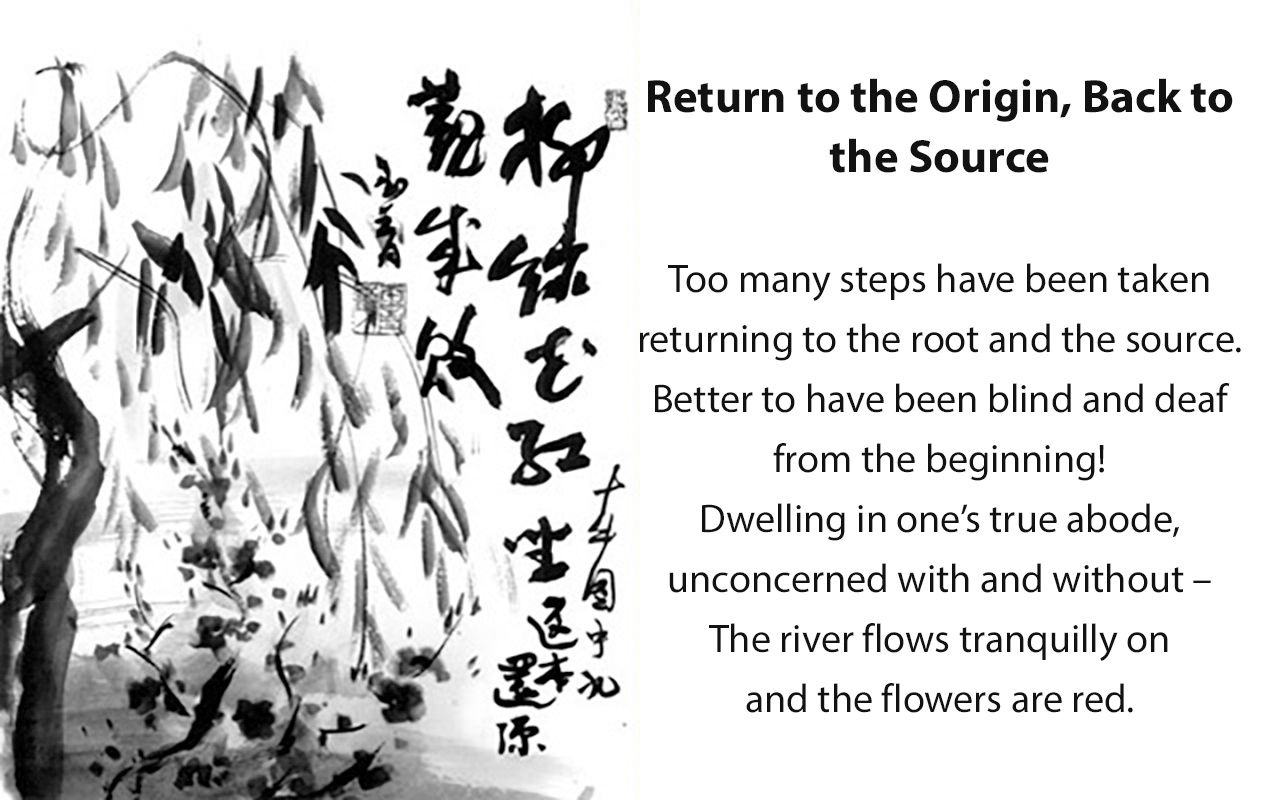
Before I go into the verse details, I want to point out something I learned recently about the use of the terms "blind and deaf." It is derogatory and harmful to use these terms in association with ignorance, something lacking or negativity. This is the way they are used in this verse and I can't undo that. But I want to note a caution that there are less discriminatory words that would say the same thing, such as "better to have been unaware or confused from the beginning." This is about ableism and we have to learn to recognize such discrimination; just like we have learned to recognize racist, homophobic, misogynistic and anti-Semitic language.
That being said, the verse can be divided into 2 parts, upper and lower. In the upper part, it acknowledges that this stage of practice comes after a long journey. It implies that it is an arduous journey and the end may not be what we expected. There is even a hint that it may have been better to not start on the path at all. Kind of like the phrase, "ignorance is bliss." This is because we are learning to sustain our attention in the midst of pain. We have an increased sensitivity to pain and suffering, which comes about due to years of practicing with pain and suffering. At this stage of practice, we no longer turn away from such pain and suffering, nor do we try to push it away. This is not about pretending that pain is not pain or suffering is not suffering. This would be spiritual bypass. What this stage of practice represents is that we are fully aware that we live in samsara. We don't need everything to be pleasing. If pain or suffering is present, we respond to it as skillfully as we can.
The bottom part acknowledges the tranquility that comes with living in this kind of sustained present moment awareness. "Dwelling in one's true abode" means you know how to come to rest and remain centered in one's own skin. The use of the term, "the river flows..." points to the ease of being available for life in this way. Finally, we come to understand that liberation, awakening, and enlightenment all point to living our lives in alignment with the Dhamma. At this stage, everything is Dhamma.
I cannot stress this enough. Although we're less likely to be unskillful in our actions at this stage, it is possible that harm flows from our actions. And even this is Dhamma. Even this is liberation. The harm itself is not liberation. What is liberating is the discernment that comes from seeing the harm. The more sensitive we become to harm (pain and suffering), the more discernment (wisdom) we have around recognizing what is skillful and what is not skillful. This leads to the ability to know how to respond in any given situation with ease.
I hope you can begin to see what is being pointed to by these pictures. How you view the ordinary moments in your daily life is significant. It is the bulk of the weight of practice. Life is more spacious at this stage of practice because you are less weighted down by your opinions, assumptions, and expectations. You are free!
With a deep bow...
Tuere
Tuere Sala | OCT 4, 2022
Share this blog post