Riding Home on the Ox
Tuere Sala | JUL 8, 2022
oxherding pictures
Riding Home on the Ox
Tuere Sala | JUL 8, 2022
We often think that a good practitioner is someone who can let go at will. But in truth, the mind remembers how to let go. It lets go on its own. This letting go is actually the unification of mind and body. It means the mind lets go of its thinking about an experience and actually joins the experience. This is what's happening in this month's picture. The yogi is no longer separate from the ox. This stage of practice is about embodiment. When I say embodiment I'm not talking about some blissful feeling of oneness. To understand this month, we need to keep "embodiment" simple. Embodiment is simply being in the present moment; in other words, having the mind and body in the same place at the same time. Your body is not doing one thing and your mind is doing something else. If the body is walking to the store, the mind is walking to the store also. If the mind is watching television or on the computer, you are aware that the body is sitting there also.
Let's turn towards the picture for a moment. You'll notice that the yogi is a reasonable size in this picture, not tiny like last month's. They're casually riding the ox with their leg up and playing the flute. They are riding the ox on its back where there is the least amount of control. In some pictures, you will see the yogi is not even looking forward, they're looking backwards. You can see the path is readily identifiable and the ox is actually watching the yogi instead of the yogi watching the ox. The verse begins with pointing out that this is a slow process. We come into embodiment slowly. It's not something that can be forced. I think the relaxed posture and playing the flute refers to the happiness of being in the present moment. What most people don't realize is that when we learn to be in the present moment, there is a natural happiness that arises with it. Phillip Moffitt calls this happiness well-being that includes non-well-being. In other words, it's a happiness that knows both pleasant and unpleasant sensations, but is not defined by either. I think the pulsating harmony refers to the connection to the breath, or our aliveness in any given moment and the knowing of Dhamma. Finally, the last lines point to the connection we have with sangha around this practice.
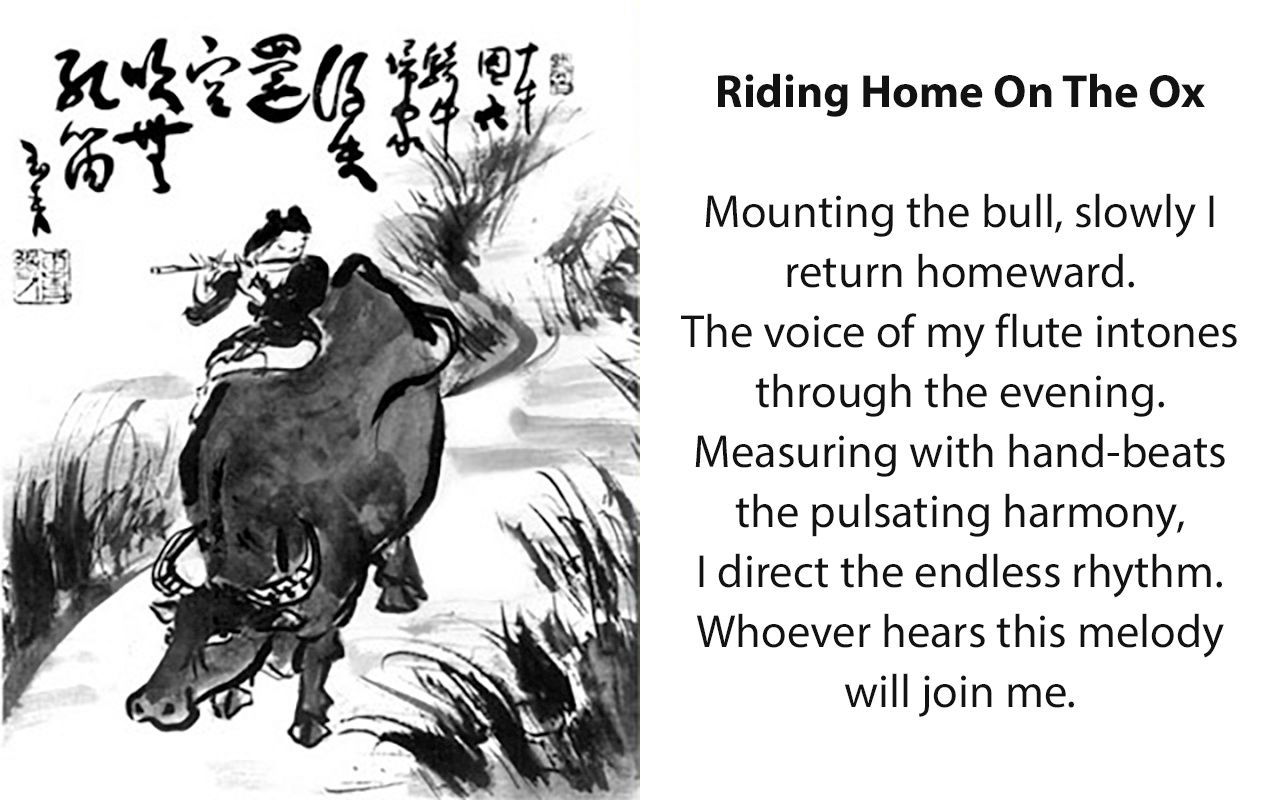
This unified way of being in the world is the early stages of non-dualism/non-self. It is the willingness to live our lives in the present moment with whatever comes. We don't live in perpetual regret nor constant worry and fear. We become fluid and capable of being free. We trust that in the Dhamma we will know the proper response. We are not worried about what lies ahead or behind. This moment exists in every practitioner's life. A moment when we let our practice guide us rather than us manipulating the practice. Instead of trying to figure out life we let the answer(s) just come to us naturally.
We can experience this in meditation and in daily life. We experience it is as letting the practice unfold however it unfolds. We stop trying to make the sit be a certain way. Home is this fathom long body. During this stage we are learning to experience the sense doors in real time, so hearing as hearing, seeing as seeing, tasting as tasting, smelling as smelling, sensing as sensing and cognizing as simply cognizing. There's no need to force this. This stage is not the end goal that we need to make happen. In other words, our practice will inevitably bring us to this place.
Tuere Sala | JUL 8, 2022
Share this blog post