The Fourth Noble Truth - The Way to the End of Suffering
Tuere Sala | APR 3, 2025
The Fourth Noble Truth - The Way to the End of Suffering
Tuere Sala | APR 3, 2025
Greetings,
This month we will be exploring the 4th Noble Truth. This truth is about the path leading to the end of suffering. In my early years of practice, I always thought that this truth and the third truth were backwards. It seems strange to be talking about the path that leads to something after you've talked about the something. I think this is because in our ordinary understanding of things, we tend to look ahead to the end goal, end result, finish line. We live in terms of finality. But remember that these truths are not rooted in finality. They are rooted in movement. They are verbs instead of nouns. This means that the so-called "end result" would be the continuous walking of the path. At this point in my practice, I understand why this truth is last. In this post, I'm going to talk about the 4th Noble Truth itself. We will go over each of the 8 path factors one at a time for the rest of the year.
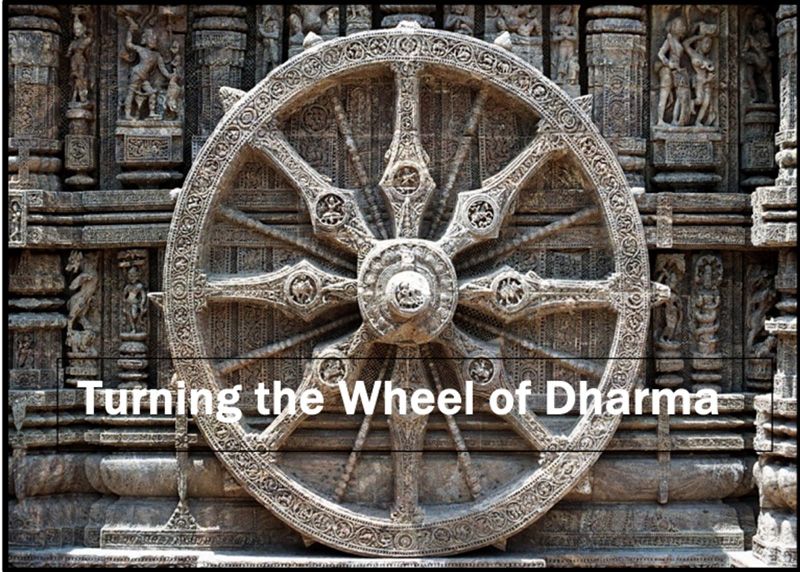
The 4th noble truth is technically just the eightfold path, which is broken up into 8 path factors divided into 3 training sections: panna or wisdom (right view, right intention), sila or ethical conduct (right action, right speech, right livelihood) and samadhi or concentration (right effort, right mindfulness, right concentration). I believe the path is divided into these training sections deliberately. When you practice them in tandem, they strengthen each other. Also I like the use of the word "right." It's not an ordinary use as in is something right or wrong. It points to liberation and identifies the "right way" to awakening. According to Luang Por Passano, "samma," which is translated as "right," was actually a commonly used word in music, meaning harmonious. Buddha took a commonly used musical term and applied it to the path so that you're walking the path in a harmonious way. Like the way harmonies blend beautifully in your favorite songs. When you think of it this way, you can see how easily the path becomes the main point. The path becomes more like a tuning fork, or like the first chair violinist who plays the A that the entire orchestra tunes towards. The path actually helps you harmoniously come to understand dukkha (1st noble truth), abandon clinging (2nd noble truth), and realize the cessation of dukkha (3rd noble truth).
How does the path do this? It begins with reframing what you consider what you are cultivating or seeking to attain. I found 3 ways of looking at this path that changed the way I practiced and moved me along the path in a much smoother way. First, I stopped considering my practice to be about conduct. I was obsessed over trying to behave a certain way and I wanted my practice to establish certain behavior patterns. But we move out of habit and trying to change habits is not the easiest thing to do no matter how much you want to change. If, however, you consider that the eightfold path is about pure energy, potentiality, possibility, then my attention is less on what I do and more on noticing my attitude, my perception, my capacity to be with experience. I began to see that as I developed the energetic power of the path itself, changes in my conduct followed. So what this means is I stopped judging myself around whether I did something skillful or unskillful and instead began to consider what conditions prompted the behavior itself. I became just as curious and interested in my unskillful conduct as I did in my skillful conduct. This simple shift in my framing really helped me see my whole life as cultivating the path. Everything belonged and nothing needed to be left out.
The second reframing I did was I made the path an inward journey. Generally when I think about path I think about going somewhere. I was always trying to get to some place with my practice. I always used my external life as the standard for how I was doing on the path. When I reframed the path as an inward journey, I began to focus more on my ability to steady myself with whatever was happening. I stopped caring so much about what was coming to me in life and more about how I was being with it internally. I began to understand more and more clearly the idea of a "precious human birth." I could see how everything that happened to me was a gift towards my progress along the path (the path meaning understanding dukkha, abandoning clinging and realizing cessation). I gradually began to see that I couldn't experience cessation if I didn't know what was ceasing, I couldn't abandon clinging if I didn't know what was dukkha, and the more I recognized the felt sense of dukkha, the more I recognized the felt sense of release. I came to realize this whole awakening process is all internal and has very little to do with the external world. The external world, it turns out, is just to give the path the energy or stimulus to move inward. In other words, the external is what provides the fuel for our practice.
The third and final reframing I came to understand was that this path is not a rehashing of what I already know. It is a path into the unknown. It rests in the present moment. A present moment that exists in impermanence. This means that nothing is the same. Everything is anew. I realized that no matter how many times I experienced the same argument with my sister, it was actually a new experience that I kept applying an old habit response. The argument sounded the same because in truth we weren't actually dealing with the present moment experience. We were just re-litigating the same argument we have every time we get together. This path into Dhamma comes alive in the present moment. It comes alive in the unknown. And it needs impermanence to stay alive. This new framing helped me realize that if I were going to find my way to awakening, I was going to have to experience something I had not experienced before. I was going to have to realize something that I could not create from my own understanding. I was going to have to see something that I had no idea even existed.
These 3 reframings of the eightfold path really supported me in bringing my retreat life, my practice life and my daily life into one path. It brought about a degree of congruency that seemed fundamental for me to stay connected to the Dhamma no matter what was happening in my life. We will explore how the path shows up in each of our lives over the month. As usual, I will offer some framings on the first Thursday to help people understand and others will offer their practice throughout the rest of the month.
With a deep bow,
Tuere
Tuere Sala | APR 3, 2025
Share this blog post